 Skip to main content

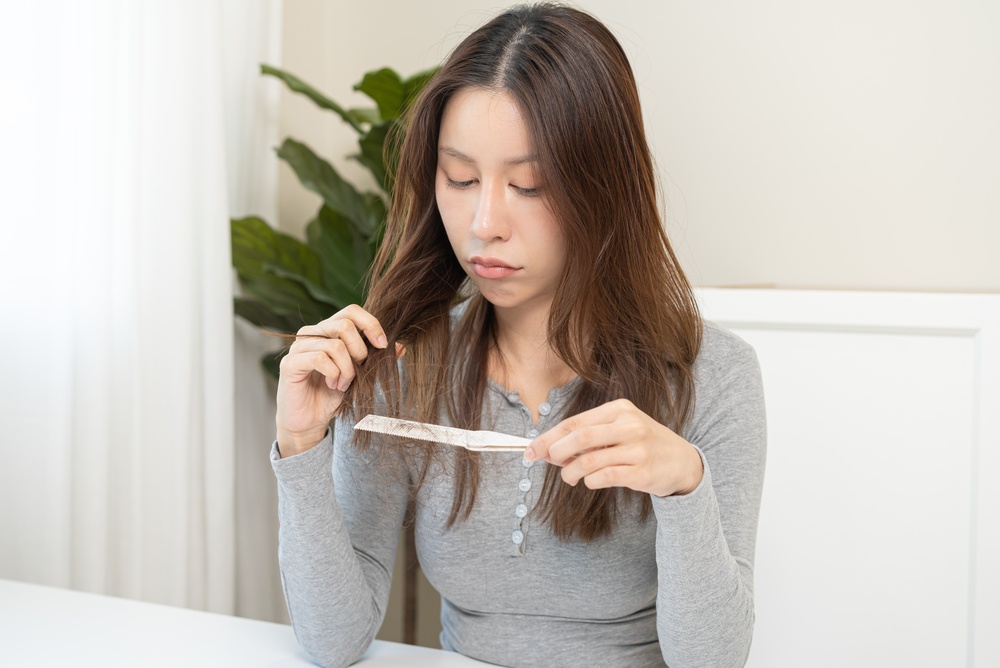
Female hair loss treatment in Singapore is a personalised process that starts by identifying the underlying cause, whether hormonal, nutritional, stress-related, inflammatory or genetic, then addressing it through medical evaluation, targeted scalp care, lifestyle changes or TCM-based hair and scalp treatment. The right combination depends on the type and cause of hair loss.
Is Female Hair Loss Different From Male Hair Loss?
Female and male hair loss overlap, but the pattern and contributing factors often differ. Women commonly experience diffuse thinning across the crown and a widening parting, rather than the more obvious receding hairline associated with male pattern baldness.
Falling oestrogen during perimenopause and menopause can affect the hair growth cycle, while androgen sensitivity contributes to female pattern hair loss, also known as female androgenetic alopecia.
Because women often retain overall coverage even as density falls, the change is easy to dismiss, and many delay seeking help, assuming it is temporary or just ageing. Understanding the pattern and likely cause early makes it easier to know whether professional assessment is appropriate.
The Stages of Female Hair Loss
The Ludwig Scale is a commonly referenced clinical classification for female pattern hair loss. It describes progressive thinning primarily across the central and crown areas rather than the pronounced frontal recession often associated with male pattern baldness.
Stage I: Mild Crown Thinning
Hair density begins to reduce around the crown, and the parting may appear slightly wider, often subtle enough to miss under normal indoor lighting.
From a TCM perspective, an assessment may consider Qi, blood and organ balance, establishing your baseline before thinning progresses.
Stage II: Noticeably Wider Parting
The central part becomes more visible, and thinning extends further across the crown, with hair often appearing flatter when styled.
Identifying contributing factors – hormonal, stress-related, nutritional or scalp-related – becomes increasingly important, so a personalised plan can target the actual driver.
Stage III: Significant Diffuse Thinning
Thinning becomes more pronounced, with the scalp increasingly visible through the hair under ordinary lighting and density noticeably reduced.
Professional assessment is particularly useful here, since several hair loss types share similar symptoms, making the cause worth establishing early.
Stage IV: Advanced Diffuse Thinning
The classic Ludwig classification is generally described in three stages, but some women experience thinning beyond typical Stage III, affecting a larger scalp area and becoming harder to conceal.
This calls for thorough assessment, since rapidly progressing loss may need medical evaluation to rule out underlying conditions.
The 5 Most Common Causes of Female Hair Loss in Singapore
Hormonal Fluctuations
Hormonal changes can influence the hair growth cycle: PCOS, contraception, pregnancy and perimenopause or menopause can all coincide with changes in hair density.
Persistent thinning alongside irregular periods, acne or increased facial hair is worth raising with a healthcare professional.
Iron Deficiency and Nutritional Factors
Low iron stores are linked to increased hair shedding, particularly in women with heavy menstrual periods or other sources of iron loss. A 2025 case-control study found ferritin significantly lower in women with telogen effluvium than in women without hair loss (24.3 ng/mL versus 44.8 ng/mL on average), with markedly reduced ferritin seen only in the hair-loss group. [1]
Ferritin is one clinical measure among several, interpreted alongside symptoms rather than as a single cut-off.
Chronic Psychological Stress
Significant stress raises cortisol and can disrupt the hair growth cycle, contributing to telogen effluvium, a type of diffuse shedding.
Shedding often becomes noticeable weeks or months after the trigger, not immediately, so identifying and addressing the underlying stressor matters for understanding the pattern.
Scalp Inflammation and Skin Conditions
Scalp problems such as seborrhoeic dermatitis can cause itching, flaking and inflammation, while product build-up can leave the scalp feeling congested.
A healthy scalp environment matters for hair growth, so persistent redness, scaling, pain or severe itching should be assessed rather than treated as ordinary hair fall.
Age-Related Follicle Changes
Hair density naturally changes with age, and some women notice thinning from their late 30s onwards, as susceptible follicles produce finer hairs.
Family history can offer useful clues, but age-related thinning should not be assumed to be the only cause when hair loss is sudden, severe or has other symptoms.
How We Approach Female Hair Loss Treatment
We take a personalised, TCM-informed approach combining consultation and scalp analysis with customised care, built around your individual condition before we recommend treatment.
Step 1: Scalp Analysis
Treatment begins with a one-to-one consultation and detailed scalp analysis to understand your concerns before recommending an approach.
Step 2: Targeted Herbal Protocol
Where appropriate, we develop treatments using TCM herbal methodology, drawing on herbs such as Dang Gui, Ginseng and He Shou Wu.
In TCM theory, Dang Gui is traditionally linked to supporting blood, while He Shou Wu is linked to kidney-related hair health. Individual suitability should be assessed by your consultant and TCM practitioner, taking into account existing medical conditions, current medications and pregnancy. He Shou Wu carries a documented caution around liver health, so anyone with a history of liver conditions should consult a doctor and our consultant before starting. [2]
Step 3: Meridian Head Massage
Our treatment approach may also include Meridian Scalp Massage, positioned around scalp circulation and TCM principles, providing targeted scalp care within a broader process rather than one technique alone.
Step 4: Monitoring and Adjustment
Hair growth follows a cycle, so changes are assessed over time, not from one session, with follow-up consultations reviewing your treatment and home-care recommendations as you progress.
When Should You Seek Professional Help for Hair Loss?
Not every episode of hair fall means female pattern hair loss. Temporary shedding can follow illness, stress, childbirth, dietary changes or other disruptions to the growth cycle.
However, persistent or rapidly worsening hair loss deserves attention, particularly with a widening part, significant density loss, bald patches, scalp inflammation or other unexplained symptoms. The pattern alone does not establish the cause: telogen effluvium, alopecia areata, scalp inflammation and female pattern hair loss can look similar, so assessment should weigh your medical history and symptoms alongside what is visible.
Read our related guide on the early signs of hair thinning for a broader overview. If your thinning coincides with perimenopause or menopause, hormonal changes are worth raising with your consultant, and our hair loss treatment overview covers types and when to seek assessment.
Frequently Asked Questions About Female Hair Loss
What Causes Hair Loss in Women in Singapore?
Female hair loss can result from several factors, including hormonal changes, female pattern hair loss, stress-related telogen effluvium, nutritional deficiencies, scalp conditions and certain medical conditions. The most likely cause depends on the pattern, timing and accompanying symptoms, so persistent or sudden hair loss should be professionally assessed.
How Do I Know if I Have Female Pattern Hair Loss?
Female pattern hair loss commonly presents as gradual thinning around the central scalp and a widening part rather than a strongly receding hairline. However, similar patterns can occur with other types of hair loss. A professional assessment can help distinguish female pattern hair loss from conditions such as telogen effluvium or scalp disorders.
What Is the Best Treatment for Female Hair Loss in Singapore?
There is no single treatment that is best for every woman because hair loss has different causes and patterns. Treatment options may include medical evaluation, addressing nutritional or hormonal factors, scalp care and personalised hair growth treatments. We use a TCM-informed approach that combines consultation, scalp analysis and customised hair and scalp treatments.
Is TCM Safe for Treating Female Hair Loss?
TCM treatments should be assessed individually, particularly when herbal formulations are involved. Tell both your own doctor and our consultant about any existing medical conditions, pregnancy, medications and supplements before beginning treatment, since some herbs carry specific cautions.[2] TCM-based hair care should also not replace appropriate medical assessment when hair loss is sudden, severe or associated with other concerning symptoms.
How Long Does Female Hair Loss Treatment Take to Show Results?
Hair growth is a gradual process because follicles move through different stages of the hair growth cycle. The timeframe varies according to the cause and individual condition, and individual results vary. Rather than expecting an immediate transformation, progress is best monitored over time through changes in hair shedding, scalp condition and visible hair density.
Take the Next Step With a Personalised Scalp Consultation
If you are concerned about female hair loss in Singapore, understanding what is contributing to it matters more than just treating the symptoms you see.
We provide one-to-one consultations and detailed scalp analysis before recommending personalised hair and scalp care. You can learn more about our hair loss treatment or book a scalp consultation at your nearest outlet: Bedok Mall, Causeway Point, Funan, JEM, NEX or Northpoint City.
References
- Thamotharan N, Harikumar MV, Sundaram M, Swaminathan A, Rangarajan S, “Assessment of Serum Ferritin Levels in Female Patients With Telogen Effluvium,” Cureus 17(12):e100249, 2025, https://pmc.ncbi.nlm.nih.gov/articles/PMC12839778/.
- NCBI Bookshelf, “Polygonum Multiflorum”, LiverTox: Clinical and Research Information on Drug-Induced Liver Injury, https://www.ncbi.nlm.nih.gov/books/NBK548795/.
